
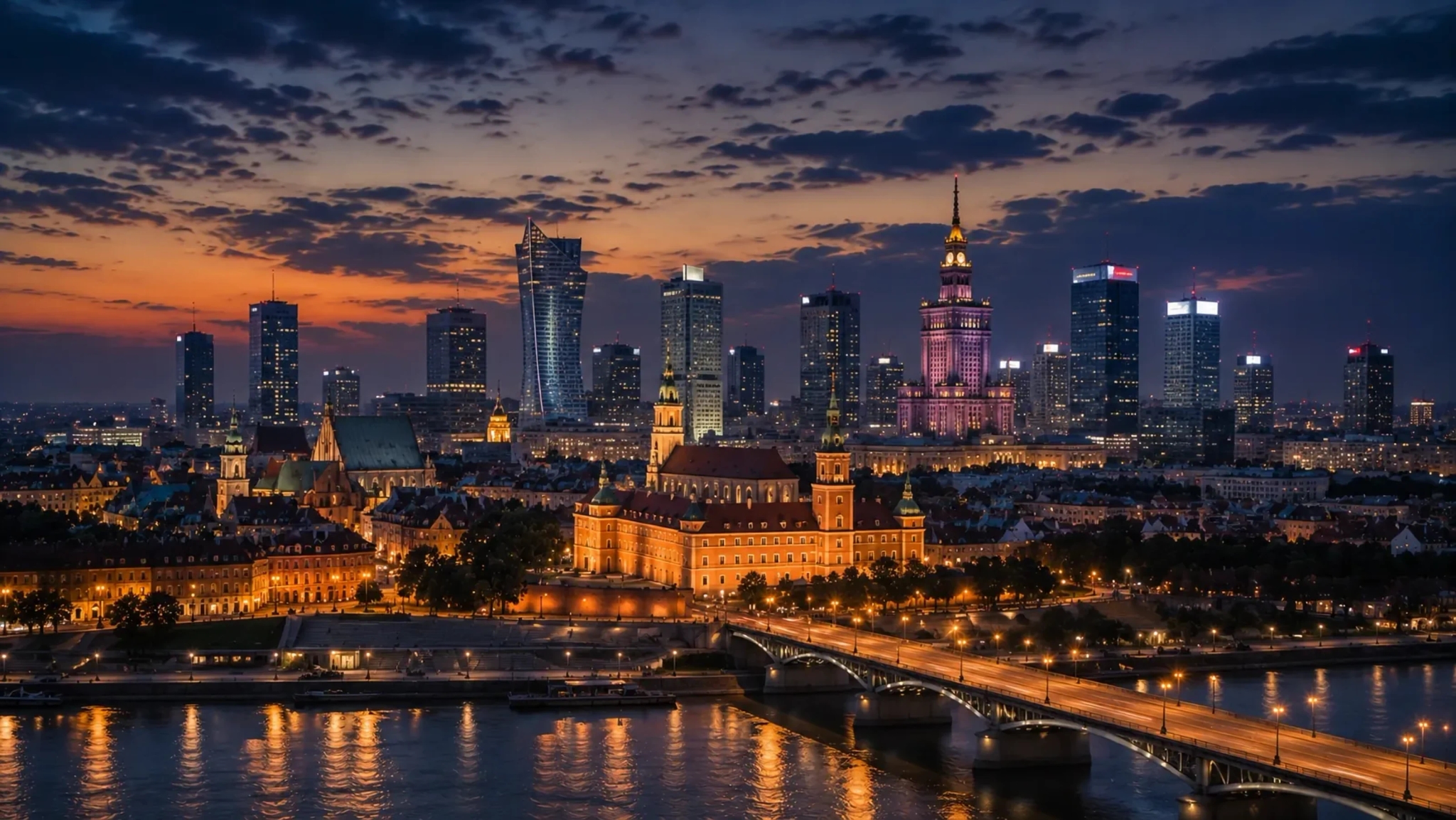
Traveler's guide • Warsaw airport
Getting to Warsaw Airport from Ukraine in 2026: Every Way, Price, Route and Tip
Warsaw is the main aviation hub for Ukrainians while Kyiv's airports remain closed to civilian flights. But "Warsaw airport" is actually two different airports on opposite sides of the city, each with its own logistics — and between you and either one sits a border whose crossing time no schedule can guarantee. This guide covers which airport is which, how far it is from nine Ukrainian cities, a comparison of bus, train, private transfer, your own car and carpooling, and a step-by-step plan for not missing your flight.
Warsaw airport from Ukraine in 2026: what to know in advance
Warsaw is Central Europe's main aviation hub for Ukrainians: direct flights leave from here to dozens of countries, and tickets are often cheaper and more accessible than through other European hubs. With Ukrainian civilian airspace closed, Warsaw's airports — alongside Kraków, Rzeszów and Lublin — absorbed most of the outbound Ukrainian passenger flow, which is why hundreds of people drive, ride a bus or take a train to Warsaw every day for a single flight.
But "Warsaw airport" isn't one point on the map — it's two different airports on opposite sides of the city, each with its own logistics: Chopin, inside Warsaw, and Modlin, 35 km north of it. Confusing the two is one of the most common reasons passengers miss their flight, when someone books a route to one airport while their ticket is for the other. Add a border with Poland that can add anywhere from 30 minutes to several hours to your estimated travel time at any moment, and it's clear why "getting to Warsaw airport" deserves a dedicated, detailed guide rather than a generic "leave early" tip.
This guide draws on official sources — the Lotnisko Chopina and Warsaw Modlin Airport websites, the gov.pl portal, PKP Intercity, Ukrzaliznytsia, the State Border Guard Service of Ukraine, and Google Maps for distances — supplemented with practical experience from the LP BLACKLINE team, who regularly drive passengers to both Warsaw airports from across Ukraine.
Carrier's tip: before booking a flight, check exactly which airport it departs from — Chopin (WAW) or Modlin (WMI). The difference in time and cost of getting there from Ukraine is often bigger than the difference in the ticket price itself.
How many airports does Warsaw have, and how do they differ
Warsaw officially has two civilian airports handling scheduled passenger flights: Frédéric Chopin Airport (Lotnisko Chopina, IATA code WAW) within the city, and Warsaw-Modlin Airport (Warsaw Modlin Airport, IATA code WMI), which actually sits in a different town — Nowy Dwór Mazowiecki, 35 km north of central Warsaw. Both handle international flights, but they serve different passenger profiles and connect to the city by different transport.
| Parameter | Chopin (WAW) | Modlin (WMI) |
|---|---|---|
| Distance to centre | ~8 km | ~35 km |
| Main carriers | LOT and network airlines | mostly budget airlines |
| Rail | station inside the terminal (SKM, Koleje Mazowieckie) | train to Modlin station + shuttle bus to the terminal |
| Buses | several city ZTM lines + a night line | direct express coaches to the centre |
| Approx. time to centre | 20–25 min by train | 40–60+ min including the ground leg |
The difference between the airports affects more than travel time — it affects the trip's budget too. If a Modlin ticket looks noticeably cheaper than a comparable Chopin flight, compare more than the airfare: compare the total cost and time of the whole door-to-door journey, especially with a family or heavy luggage.
Sources: Lotnisko Chopina — official site, Warsaw Modlin Airport — official site.
Warsaw Chopin Airport (WAW): how to get there
Chopin Airport is Poland's largest and busiest, about 8 km south of central Warsaw, in the Włochy district. It's the home hub of LOT Polish Airlines and the main arrival point for most network carriers flying to Warsaw — so it's typically where connecting flights through other European hubs land.
Train — the fastest way into the centre
The underground station "Warszawa Lotnisko Chopina" sits directly beneath the terminal — no shuttle transfer required. It's served by the SKM fast urban rail lines S2 (toward Sulejówek Miłosna via Warszawa Wschodnia and Warszawa Śródmieście) and S3 (toward Legionowo, Radzymin and Wieliszew through the city centre), plus Koleje Mazowieckie commuter trains. The ride to central stations takes about 20–25 minutes. Fares are standard ZTM tickets: a 75-minute ticket in zone 1 costs 4.40 PLN (2.20 PLN reduced) and covers unlimited transfers within that time.
Buses
- Line 175 — from Piłsudski Square through the city centre (Krakowskie Przedmieście, Nowy Świat, Aleje Jerozolimskie).
- Line 188 — from Praga-Południe via the Łazienkowska route (near Politechnika metro station).
- Line 148 — from Praga-Południe through Mokotów and Ursynów (Imielin metro station).
- Line 331 — from Wilanowska metro station, weekday peak hours only.
- Night line N32 — to the Central Station when the metro and daytime buses aren't running.
Taxis and the Kiss&Fly zone
An official taxi rank, marked with a yellow line on the floor, sits right outside the terminal exit. Three licensed taxi corporations — ELE TAXI, SUPER TAXI and SAWA TAXI — are authorised to pick up passengers there, with metered fares; a ride to central Warsaw runs roughly 35–50 PLN depending on time of day (more at night, on Sundays and holidays). If you're picking someone up in your own car, the Kiss&Fly zone gives the first seven minutes free, with a 7–15 minute stop costing 30 PLN.
How much time to allow for check-in
Chopin Airport's official recommendation is to arrive 2 hours before departure for Schengen-zone flights and 3 hours before long-haul flights. Check-in for short European flights typically closes 30 minutes before departure, and an hour before for long-haul flights; after that point, even a confirmed e-ticket won't get you on board.
Parking and terminal facilities
Terminal A at Chopin Airport houses all scheduled flights in a single building, so there's no confusion between multiple terminals as at some larger European hubs — the only mix-up to avoid is the airport itself, Chopin versus Modlin. Short- and long-term parking sit near the terminal, alongside the Kiss&Fly zone already mentioned. If you're meeting someone at night or picking up a group with luggage, the Kiss&Fly zone is more convenient than paid parking for a quick stop.
Sources: Lotnisko Chopina — public transport, Warszawa19115.pl — getting to the airport, Lotnisko Chopina — check-in.
Warsaw-Modlin Airport (WMI): how to get there
Modlin Airport sits about 35 km north of central Warsaw, near the town of Nowy Dwór Mazowiecki, on a former military airfield. It's mostly a "budget" airport: low-cost carrier tickets from here are often cheaper than comparable Chopin flights, but weigh that saving against the extra time and cost of ground transport into the city itself.
Train + shuttle bus
The airport has no rail station of its own — the nearest one, "Modlin", sits a few kilometres away, connected to the terminal by a dedicated shuttle bus every 20–30 minutes, timed to train arrivals and departures; the shuttle ride itself takes about 10 minutes. Modlin station is served by Koleje Mazowieckie commuter trains as well as long-distance TLK and EIC services. Koleje Mazowieckie offers a combined "Airport Ticket" (Bilet Lotniskowy) covering both the train and the shuttle bus for roughly 18–23 PLN, with no need to buy each leg separately.
Direct express buses
An alternative to the train is a direct coach from the terminal straight to central Warsaw, skipping the transfer at Modlin station; such services are run by, among others, FlixBus and ContBus, taking about an hour depending on traffic. This is a convenient option if you're landing late at night and don't want to work out the commuter train timetable.
Taxis
A taxi from Modlin costs noticeably more than from Chopin, simply because of the 35 km distance. Agree on an approximate fare in advance, or use the official rank by the terminal rather than offers from people in the arrivals hall.
The main practical tip for Modlin is to plan the ground leg of the journey as carefully as the flight itself: the airport is compact, and after a late flight it helps to already know whether you'll still catch a Koleje Mazowieckie train, or need to wait for a night bus, or should book a transfer in advance. If your flight lands at night, a pre-booked private transfer removes the risk of being stuck in an empty arrivals hall with no way into town.
Sources: Warsaw Modlin Airport — official site, Koleje Mazowieckie — Airport Ticket.
Which airport to choose: Chopin or Modlin
If you have a choice of flights — say, comparing a few options before booking — weigh more than the ticket price: factor in how much it will cost and how long it will take to reach the airport itself from Ukraine, and afterwards, once you've landed.
- Chopin is more convenient if you're travelling without a car and want the fewest transfers — the rail station sits right in the terminal.
- Chopin receives more network-carrier flights and connecting routes through other European hubs.
- Modlin often offers cheaper low-cost tickets, but adds at least 30–60 minutes and a separate ground-transport cost on both ends of the trip.
- For families with children, heavy luggage, or overnight flights, Chopin's advantage is more pronounced — fewer transfers and logistical risks.
- If you're travelling by private transfer, the difference between the airports largely disappears: the fare is agreed in advance regardless of which of the two airports you're flying from, and the driver takes you straight to the terminal door with no transfers.
Rule of thumb: compare the full door-to-door cost of the trip, not just the airfare — including the drive to the border, the wait there, and ground transport once in Poland. A cheaper Modlin ticket sometimes ends up costing more time and money than a slightly pricier Chopin flight.
There's also a third scenario, where the airport choice isn't up to you at all — the ticket is already booked, and the only question is how to get there. In that case, treat the chosen airport's quirks as a given: for Chopin, budget for Warsaw's own rush-hour traffic; for Modlin, make sure the last convenient train or bus lines up with your arrival or departure time rather than hoping you'll "somehow make it".
How far is it to Warsaw from different Ukrainian cities
The distances below are an approximate driving-route calculation to the nearest suitable checkpoint and on to Warsaw. Actual distance and time depend on the checkpoint chosen, road conditions, and — most of all — the border queue, which no route planner can predict in advance. The "including the border" figure is an approximate range based on typical waits; always check the current border situation before you leave (see "How the border crossing works" below).
| City | Distance, km | On the road, excluding the border | Including the border (approx.) |
|---|---|---|---|
| Kyiv | ~720 | 9–10 h | 10–13 h |
| Lviv | ~540 | 6.5–7 h | 7.5–9 h |
| Odesa | ~1,180 | 14–15 h | 16–19 h |
| Chernivtsi | ~760 | 9–9.5 h | 11–13 h |
| Vinnytsia | ~720 | 8.5–9 h | 10–12 h |
| Ternopil | ~630 | 7.5–8 h | 9–11 h |
| Khmelnytskyi | ~680 | 8–8.5 h | 9.5–11.5 h |
| Ivano-Frankivsk | ~680 | 8–8.5 h | 9.5–11.5 h |
| Uzhhorod | ~830 | 10–10.5 h | 12–14 h |
Notice that the gap between "clean" driving time and time "including the border" runs from one to three hours for almost every city — and that gap is exactly what eats into a schedule planned on straight-line distance alone. When planning departure for a specific flight, work from the right-hand column, not the "clean" distance a plain navigation app shows without accounting for the border.
Sources: calculations based on Google Maps and LP BLACKLINE's own routing data. Uzhhorod has no checkpoint of its own into Poland — local crossings lead to Slovakia and Hungary, so the route to Warsaw runs through Lviv region.
Getting to Warsaw airport from Kyiv
Kyiv is the best-served direction: every method of reaching Warsaw operates here, and most carriers run several departures a day. The distance is about 720 km, with the typical route running through Zhytomyr, Rivne and Lutsk to the Yahodyn – Dorohusk checkpoint, or through Zhytomyr and Lviv region to Krakovets or Shehyni, depending on the carrier or chosen route.
- Train — Ukrzaliznytsia runs a direct No. 67/68 "Kyiv – Warsaw" train to Warszawa Wschodnia station, plus trains to Przemyśl (No. 715/716 "Intercity+" and others) connecting onto PKP Intercity trains toward Warsaw.
- Bus — FlixBus and Sindbad run several daily direct Kyiv – Warsaw coaches, some arriving straight at Modlin airport.
- Private transfer — LP BLACKLINE runs the Kyiv — Warsaw route daily, picking up at any address in Kyiv and dropping off at either airport's terminal.
- Own car — the most flexible option given a valid Green Card and enough time budgeted for the border queue.
Sources: Ukrzaliznytsia — train timetable, FlixBus — Kyiv – Warsaw route.
Getting to Warsaw airport from Lviv
Lviv is the regional city closest to the border, and so the shortest route to Warsaw: about 540 km through one of the six checkpoints in Lviv region (most often Krakovets – Korczowa or Shehyni – Medyka), then along the Polish motorway via Rzeszów. That's why many travellers from central and southern Ukraine fly out via Lviv on the first leg, combining a domestic transfer with the international one that follows.
- Bus — FlixBus, Sindbad and other carriers run daily direct Lviv – Warsaw coaches; some take longer than the formal travel time due to intermediate stops in Polish towns.
- Train — occasional direct and connecting rail links between Lviv and Warsaw appear via border stations; check the current timetable on uz.gov.ua before travelling, since international routes change from time to time.
- Private transfer — LP BLACKLINE arranges Lviv – Warsaw trips on request, with the driver choosing whichever checkpoint is less busy.
- Own car — given the short distance, this is one of the most popular options specifically from Lviv region.
Sources: State Border Guard Service — Lviv region checkpoints, FlixBus — Lviv – Warsaw route.
Getting to Warsaw airport from Odesa
Odesa is the furthest of the regional cities covered in this guide from the Polish border: about 1,180 km, which in practice means a full day's journey once the border is included. A non-stop drive is physically exhausting, so this is the one direction worth seriously weighing against a train with a connection, or a trip split into two stages.
- Train — Ukrzaliznytsia runs the express No. 35/36 "White Acacia" Odesa – Przemyśl; at Lviv it effectively continues the route of train No. 51 Kyiv – Przemyśl, and at Przemyśl you can change onto PKP Intercity trains to Warsaw or Kraków.
- Bus — direct Odesa – Warsaw services are less frequent than from Kyiv or Lviv; most carriers route passengers through a change in Lviv, Kovel or Lutsk.
- Two-stage option — take a domestic flight or train to Kyiv or Lviv and pick up a direct service to Warsaw from there.
- Private transfer for the full route — possible, but given the distance it's worth treating as a full-day trip with mandatory rest stops for the driver; discuss the specifics individually.
Sources: Ukrzaliznytsia — train timetable.
Getting to Warsaw airport from Chernivtsi
From Chernivtsi to Warsaw is about 760 km, with the route running mostly through Ivano-Frankivsk and Lviv to one of the Lviv region checkpoints. Direct bus service from Chernivtsi to Warsaw is limited, so several carriers offer a connecting trip through Lviv or Ivano-Frankivsk instead.
- Bus — check carrier sites (FlixBus, Sindbad) for a direct service; failing that, a combined route via Lviv.
- Train — there's no direct fast rail link to Przemyśl from Chernivtsi; it's more efficient to reach Lviv or Ivano-Frankivsk first and use the rail or bus links from there.
- Private transfer — removes the need for transfers, and particularly worthwhile here given the lack of convenient direct public transport.
- Own car — realistic given the moderate distance; just budget extra time for the mountainous Carpathian foothills stretch.
Since there's no direct international rail link from Chernivtsi to Poland, and bus services aren't as frequent as from Kyiv or Lviv, this is one of the directions where advance planning matters most. Once your flight date and time are set, compare not only the fare of a bus with a connection but the total travel time: a Lviv layover waiting for the next departure can add several hours compared with a direct private transfer.
Getting to Warsaw airport from Vinnytsia
From Vinnytsia to Warsaw is about 720 km, comparable to the distance from Kyiv. There are two main route options: via Zhytomyr, Rivne and Lutsk to Yahodyn, or via Khmelnytskyi and Lviv region to Krakovets or Shehyni — the choice depends on which checkpoint is currently less busy.
- Bus — regular Warsaw-bound services from Vinnytsia are mostly transit stops on a longer route; check the bus's arrival time in Vinnytsia on the carrier's site.
- Train — it's more convenient to reach Kyiv on a domestic service and use the direct No. 67/68 train to Warsaw from there.
- Private transfer — a direct departure from Vinnytsia with no need to first reach Kyiv or Lviv.
- Own car — a flexible option, with the ability to pick a less busy checkpoint on the road.
Vinnytsia sits roughly equidistant from the two border directions — Volyn via Yahodyn and Lviv region via Krakovets or Shehyni — so the route is worth choosing based on the actual queue situation rather than habit. For passengers without a car, the simplest option is a domestic train or bus to Kyiv (about 3–4 hours) followed by a direct international service, or booking a private transfer straight away that picks up in Vinnytsia and drops off at the terminal with no intermediate stop.
Getting to Warsaw airport from Ternopil
Ternopil sits conveniently close to the border: about 630 km to Warsaw, with the route running mostly through Lviv to Krakovets, Shehyni or Rava-Ruska. This is one of the directions where the difference between Lviv region checkpoints is noticeable — worth checking the queue at a few of them right before departure.
- Bus — some Lviv – Warsaw services make an intermediate stop in Ternopil; check this on the FlixBus and Sindbad sites before buying a ticket.
- Train — it's more efficient to reach Lviv on a domestic service and use the direct or connecting route to Przemyśl or Warsaw from there.
- Private transfer — a direct departure from Ternopil with no intermediate stop in Lviv.
- Own car — a typical journey of 7.5–8 hours excluding the border, realistic for a single-day trip.
Given the short distance to the border, it's possible to leave Ternopil the same morning even for an evening flight — but only if the time buffer deliberately accounts for a possible queue, not just the formal driving time. If travelling by bus with an intermediate stop in Ternopil, confirm a guaranteed rather than approximate boarding time — a transit stop's schedule tends to "drift" with the border situation more than a departure from the route's starting point does.
Getting to Warsaw airport from Khmelnytskyi
From Khmelnytskyi to Warsaw is about 680 km. The route can run either through Ternopil and Lviv to the Lviv region checkpoints, or through Rivne and Lutsk to Yahodyn on the Volyn side — both options are roughly equal in distance.
- Bus — direct services are less frequent than from Lviv or Ternopil; check for transit services through those cities.
- Train — reach Lviv or Kyiv on a domestic service and use the international link from there.
- Private transfer — removes the need for a domestic connection before crossing the border.
- Own car — roughly 8–8.5 hours on the road excluding the border.
Khmelnytskyi is a city where neither border direction (Volyn via Yahodyn or Lviv region via Krakovets and Shehyni) has a clear distance advantage, so the choice is best made on the day, based on wherever the queue is shorter. For passengers without a car, it's more practical not to hunt for a direct bus from Khmelnytskyi, but to compare two options: reaching Lviv and using its denser network of international services, or booking a private transfer straight away and skipping the intermediate leg entirely.
Getting to Warsaw airport from Ivano-Frankivsk
From Ivano-Frankivsk to Warsaw is about 680 km via Lviv and one of the Lviv region checkpoints. FlixBus runs a daily direct service on the route Ivano-Frankivsk – Lviv – Lublin – Warsaw, making this one of the more convenient Carpathian-region cities for bus travel.
- Bus — a daily direct FlixBus service via Lviv and Lublin to Warsaw, taking roughly 12 hours depending on the border.
- Train — no direct rail link to Przemyśl from Ivano-Frankivsk; the best option is to reach Lviv and change there.
- Private transfer — a direct departure with no transfers, convenient for families and business trips.
- Own car — roughly 8–8.5 hours on the road excluding the border.
Sources: FlixBus — Ivano-Frankivsk – Warsaw route.
Getting to Warsaw airport from Uzhhorod
Uzhhorod is a special case among the directions in this guide: Zakarpattia region doesn't border Poland, and the local checkpoints lead to Slovakia and Hungary instead. So any route from Uzhhorod to Warsaw physically runs through Lviv region — adding distance and time compared with other western Ukrainian cities. The approximate distance is about 830 km.
- Bus — direct Uzhhorod – Warsaw services do exist (run by individual carriers), but the journey is long — around 19 hours, since the route detours through Lviv region.
- Train — there's no direct fast rail link from Uzhhorod to Przemyśl or Warsaw; it's more efficient to take a domestic train to Lviv and use the international connections from there.
- Private transfer — given the distance and lack of convenient direct public transport, this often ends up comparable in time to a direct bus, but noticeably more comfortable.
- Own car — realistic if you're prepared to spend 10–10.5 hours on the road alone, excluding the border.
Every way to reach Warsaw: a comparison
The five main ways to reach Warsaw from Ukraine — bus, train, private transfer, your own car, and carpooling — suit different budgets, group sizes, luggage amounts, and how critical your exact arrival time is. The table below gives an overview; details on each method follow in the sections after it.
| Method | Comfort | Transfers | Best for |
|---|---|---|---|
| Bus | basic | usually none, but a shared queue with other passengers | budget trips with light luggage, flexible arrival time |
| Train | medium–high | often requires a change onto a Polish train | rail enthusiasts, those comfortable planning a connection |
| Private transfer | high | none, door to door | flights with a fixed departure time, families, luggage, night trips |
| Own car | depends on the car | none, but all responsibility for documents and driving is yours | those who own a car, hold a valid Green Card, and are comfortable driving it themselves |
| Carpooling | unpredictable | no formal transfers, but dependent on the driver's schedule and route | budget solo trips without luggage, with a flexible schedule |
Bus: pros, cons, who it suits
The bus is the most accessible way to reach Warsaw without a car. FlixBus and Sindbad run several daily services from Kyiv, Lviv and other major cities, some arriving directly at Modlin airport rather than just central Warsaw.
- Pros: the lowest fare of any method, a wide network of routes, luggage usually included in the base fare.
- Cons: a shared queue at the border — if one passenger's documents raise a question, the whole bus is delayed; a fixed schedule with no flexibility; intermediate stops add time.
- Approximate travel time: 10–14 hours from Kyiv and Lviv, longer from more distant cities — depending on the border and the number of stops.
- Transfers: usually not needed on direct routes, but smaller cities often require a connection through Lviv or Kovel.
- Comfort level: basic — fixed seating, an onboard toilet isn't always available, Wi-Fi and power outlets are common on newer coaches.
- Best for: passengers travelling light with a flexible flight time who don't mind spending more time for a lower price.
When choosing a specific service, check the final stop in Warsaw, not just the price: some buses arrive at the "Warszawa Zachodnia" (Western) bus station or other central stops, while a few run straight to Modlin airport's terminal, removing the need for a further transfer. This matters particularly if your flight is out of Modlin: a direct bus from Ukraine to the terminal can be more convenient than combining "bus to central Warsaw" with a separate airport transfer.
Sources: FlixBus — official site, Sindbad — official site.
Train: pros, cons, who it suits
Ukrzaliznytsia runs 11 international services to Poland from seven Ukrainian cities, including the direct No. 67/68 Kyiv – Warsaw train and services to Przemyśl and Chełm, where you can change onto PKP Intercity trains to Warsaw. This method combines reasonable comfort with schedule predictability, though it requires attention to connections.
- Pros: more space and comfort than a bus, freedom to move around the carriage, less dependence on the road queue that affects cars (though border and customs checks on a train take time too).
- Cons: not every route is direct — a change onto a Polish train at Przemyśl or Chełm is often required; international timetables change periodically, so verify current details right before travelling.
- Approximate travel time: Kyiv – Warsaw direct is roughly 14–15 hours; Kyiv – Przemyśl is about 9 hours, plus a further connection onto PKP Intercity toward Warsaw (a few more hours).
- Transfers: often required at border stations — Przemyśl or Chełm — where you change onto a European-gauge train.
- Comfort level: medium–high, especially in sleeper compartments on overnight services.
- Best for: passengers uncomfortable with a road queue at the border, and those willing to plan a connection in advance.
Bear in mind that trains at border stations like Przemyśl or Chełm undergo a gauge change or a change onto a European-width train — a normal part of the journey rather than a fault, but one that adds waiting time worth budgeting separately from the train's actual running time. For passengers with heavy luggage, hauling suitcases between trains during a connection can be less convenient than it looks on paper — worth weighing when choosing between a train and a direct bus or transfer.
Sources: Ukrzaliznytsia — scheduled passenger train timetable, PKP Intercity — official site.
Private transfer: when it's worth it
A private transfer removes the main problem of getting to the airport — dependence on someone else's schedule. Instead of fitting your departure time to a bus or train timetable, and then to Warsaw's own local transport timetable, you agree a pickup time built around your specific flight and go from an address in Ukraine to the airport terminal without a single transfer.
- No transfers — door to door, including drop-off right at the Chopin or Modlin terminal.
- A fixed price agreed in advance — regardless of how long the border queue turns out to be.
- Help with luggage and the ability to carry more than a bus or airline allowance permits.
- A comfortable car and the chance to rest or work en route, instead of tracking connections.
- Waiting through a flight delay or border delay — the driver adapts to the real timing, not a fixed schedule.
- The option to leave at night for an early-morning flight, when public transport isn't running yet.
- A route tailored to conditions — the driver picks whichever checkpoint is less busy.
LP BLACKLINE runs the Kyiv — Warsaw route on a regular basis, picking up at any address and dropping off at the specific airport terminal, and arranges trips from other Ukrainian cities on request. The price is agreed before the trip and doesn't change even if the border wait runs longer than expected — that risk sits with the carrier, not the passenger.
Booking a transfer is usually a few simple steps: you share the flight date, time and pickup address, agree the route and passenger count, get a fixed price — and on the day, the driver arrives with a buffer built in for the road and the border. The earlier you book, the easier it is to fine-tune the ideal departure time, especially for night and early-morning flights when public transport isn't running yet.
Own car: pros, cons, who it suits
Your own car gives maximum flexibility over departure time and checkpoint choice, but shifts onto you all the responsibility for the vehicle's paperwork, its technical condition, and finding your way around an unfamiliar city at the end of a long drive.
- Pros: full control over the route and departure time, the freedom to stop anywhere, no dependence on a carrier's schedule.
- Cons: requires a valid Green Card, responsibility for airport parking (paid at both Chopin and Modlin), fatigue from a long solo drive, especially before a night flight.
- Approximate travel time: per the distance table above, plus an unpredictable border queue.
- Transfers: none, but the driver has to track the queue situation and switch checkpoints if needed.
- Comfort level: depends on the car and the number of passengers.
- Best for: experienced drivers who cross the border regularly, and those planning to stay in Poland longer than one flight.
If you're planning to leave the car in long-term airport parking for the whole trip, work out the daily parking cost separately — for a week or longer it often approaches the cost of a couple of round-trip bus or train tickets, while the car simply sits there. In that case, it's worth comparing your own car against a private transfer specifically for a "fly out and fly back" trip, rather than a longer road trip around Europe.
Carpooling: pros, cons, who it suits
Finding a ride-share through messenger communities or carpooling services is the cheapest way to reach the border, or even Warsaw itself, if a driver happens to be going there. It's also the least predictable option covered in this guide.
- Pros: typically the lowest cost of the trip, and flexibility to negotiate directly with a specific driver.
- Cons: no formal carrier accountability for a delay or a cancelled trip, an unknown level of comfort and driving experience, limited luggage space.
- Approximate travel time: entirely dependent on the specific driver and the route they choose.
- Transfers: usually none, if the driver is going straight to Warsaw.
- Comfort level: unpredictable — from perfectly comfortable to cramped, depending on the car and the number of other passengers.
- Best for: solo travellers with a flexible schedule who aren't flying on a fixed departure time and accept some unpredictability in exchange for savings.
Important: if your flight has a firm departure time, carpooling is the riskiest option of all — no guarantees on departure time, route, or even whether the trip happens on the stated day.
How much the trip to Warsaw airport costs: ballpark figures
Carrier prices change through the season and by booking date, so the figures below are only benchmarks from official carrier sites at the time of publication — always check the current fare directly on the carrier's site before travelling.
| Method / service | Approximate cost | Benchmark source |
|---|---|---|
| Kyiv – Warsaw bus (FlixBus) | from ~53 USD one way | flixbus.com |
| Uzhhorod – Warsaw bus (direct) | roughly 3,200 UAH | carrier site |
| ZTM 75-minute ticket (Chopin airport — centre) | 4.40 PLN (2.20 PLN reduced) | wtp.waw.pl |
| Combined "Airport Ticket" Modlin (train + shuttle) | roughly 18–23 PLN | mazowieckie.com.pl |
| Taxi from Chopin airport to the centre | roughly 35–50 PLN | the airport's official taxi rank |
| Kiss&Fly zone (Chopin), 7–15 min stop | 30 PLN (first 7 min free) | lotnisko-chopina.pl |
A private transfer usually costs more per person than a bus or train ticket, but the right comparison isn't cost "per ticket" — it's cost "per trip". For a family travelling with several suitcases, the price of a transfer per car often works out comparable to or cheaper than several separate bus or train tickets plus a taxi in Warsaw — with no transfers along the way.
Sources: FlixBus — Kyiv – Warsaw route, Warszawski Transport Publiczny, Koleje Mazowieckie — Airport Ticket, Lotnisko Chopina.
How the border crossing works on the way to Warsaw
Whichever method you choose, the road to Warsaw runs through one of the nine road checkpoints on the Ukraine–Poland border (or the equivalent rail checkpoint for a train) — all operate around the clock but vary a great deal in how busy they are. Leaving Ukraine, a car or train goes through border and customs control; entering Poland, it goes through a check against the Schengen entry conditions.
For anyone flying on a fixed departure time, the key takeaway is simple: the border queue is a variable that can't be reduced to zero, but the risk of it affecting your flight can be cut substantially by deliberately budgeting time for it, rather than hoping for "the usual 20–30 minutes". That's why experienced carriers treat the border not as a formality a few minutes from the end of the route, but as a separate, unpredictable leg of the trip with its own time buffer.
- Track the queue in advance — the State Border Guard Service's Telegram channel, the "Cherga" app, or the granica.gov.pl portal on the Polish side.
- Avoid leaving on Friday evening, Sunday, or the day before a holiday — traditionally the busiest periods.
- Carry original documents, not just photos on your phone.
- Men of conscription age should prepare a full set of documents proving their ground for travel in advance.
This is a brief overview — a full breakdown of all nine checkpoints, required documents, customs rules, and the rules for men of conscription age is in the dedicated guide "Ukraine – Poland Border Crossing: The Complete 2026 Guide". If a man of conscription age is travelling with you, it's also worth reading "Crossing the Ukrainian Border as a Man of Conscription Age in 2026" in advance.
Sources: State Border Guard Service — checkpoints, granica.gov.pl.
Which documents you need for the trip
The basic document set for a trip to Warsaw airport from Ukraine is the same regardless of the method chosen, with an addition for those crossing the border in their own car.
- A biometric international passport — required for visa-free entry to Poland; stays are capped at 90 days within any 180-day period.
- A flight ticket or booking confirmation — not formally required at the border, but it noticeably speeds up the check since it confirms your purpose and trip length.
- For your own car — vehicle registration, a driving licence, and a valid Green Card covering Poland.
- For men aged 18–60 — a military registration document and, if required, documents proving the ground for travel.
- For children — their own passport or, during martial law, an entry in a parent's passport or a birth certificate; a notarised consent from the other parent where required.
- Travel medical insurance — not formally required with a biometric passport, but practically necessary to cover any medical care needed en route.
Also keep customs limits in mind — they apply regardless of your travel purpose: cash of €10,000 or more must be declared in writing, and personal products of animal origin — meat, lard, cheese, dairy — cannot be brought into the European Union even in small quantities for personal use. If you're connecting through another EU airport, these rules apply from the moment you cross the land border, not just at customs at your departure airport.
A full breakdown of documents, exceptions, and reasons for a refused crossing is in the guide "Ukraine – Poland Border Crossing: The Complete 2026 Guide".
When it's best to leave
When you leave home affects the trip to the airport just as much as the transport method you choose — which is why the border queue is best treated not as a fixed number but as a variable that depends on the day of the week and time of day.
- Avoid leaving on Friday evening, Sunday, or the day before a public holiday — traditionally the busiest periods at the border.
- Leaving early morning or at night usually means a shorter queue than during the day.
- Load on all checkpoints rises in summer and around public holidays — budget extra time.
- Queues are generally shorter in winter, but factor in possible delays from weather conditions on the approach roads.
- For a morning flight, plan to leave the evening before if you're coming from a distant city — this reduces the risk of the queue eating your entire time buffer.
How much time to budget before your flight
General rule: add to the airport's official recommendation (2 hours before Schengen-zone flights, 3 hours before long-haul ones) all the time needed for the drive from Ukraine, including a buffer for the border queue. For most cities, that means leaving the day before, or at least many hours ahead, rather than "that same morning".
| Departing from | Minimum buffer before departure (aside from the airport itself) |
|---|---|
| Lviv, Ternopil, Ivano-Frankivsk, Khmelnytskyi | 10–12 h before your target airport arrival time |
| Kyiv, Vinnytsia, Chernivtsi | 12–15 h before your target airport arrival time |
| Odesa, Uzhhorod | 16–20 h before your target airport arrival time |
Tip: for a morning flight from far away, consider leaving the evening before, arriving in Warsaw after dark with a short rest before the airport, rather than trying to make it "in one go" without a border buffer.
How not to miss your flight: a step-by-step plan
- A few days before departure, confirm which airport your flight is from — Chopin or Modlin — and work out the time for each way of getting there.
- Choose a travel method based on your luggage, passenger count, and how critical an exact arrival time is.
- The day before you leave, check the current border queue via the State Border Guard Service's Telegram channel or the "Cherga" app.
- Gather the full document set — passports, vehicle documents (if applicable), a military registration document, flight booking confirmation.
- Plan a departure buffer that covers both the border queue and the airport's official recommendation to arrive 2–3 hours ahead.
- If driving or taking the bus, keep a backup option in hand (say, a private carrier's number) in case the border situation suddenly worsens.
- Right before you leave, double-check the departure terminal in your booking confirmation — airlines occasionally change terminals the day before a flight.
Pre-trip checklist for Warsaw airport
A short list to run through the day before departure, whichever way you're getting to the airport.
Documents
- Biometric international passport (valid for the whole trip, with a buffer).
- Flight booking confirmation with the exact airport name and IATA code.
- Military registration document and, if needed, a ground for travel — for men aged 18–60.
- Vehicle documents and a valid Green Card — if driving your own car.
- Travel medical insurance for the trip.
- The child's documents and, if required, notarised consent from the other parent.
Logistics
- Confirmed which airport the flight is from — Chopin or Modlin.
- Chosen a travel method based on luggage and passenger count.
- Booked a bus/train ticket or agreed a transfer pickup time.
- Checked the current border queue situation the day before departure.
- Calculated a departure time with a buffer for the border and the airport's 2–3 hour recommendation.
On the road
- A full fuel tank (if driving) or a charged phone and a power bank.
- Paper copies of key documents, kept separately from your phone.
- Water, snacks, and everything needed for children if travelling with a child.
- The carrier's or driver's contact details on hand in case of a schedule change.
Tips from experienced international carriers
Over years of regular trips to Warsaw's airports, the LP BLACKLINE team has picked up a few practical rules rarely written into official guides.
- Never plan a departure that leaves no margin — the border queue doesn't care how much you need to make it in time.
- Confirm the departure terminal in advance: Chopin and Modlin are different airports, not terminals of the same one, and mixing them up costs far more than it seems it should.
- Keep a paper copy of your flight booking — a dead phone at the border or the airport isn't rare.
- For an early-morning flight, consider a night departure or an overnight stay in Warsaw the evening before — it cuts the risk of missing the flight due to overnight driving fatigue.
- For families with children or elderly passengers, budget more time for connections and breaks than for a solo business trip.
- Check the weather forecast along the whole route, not just in Warsaw — snow or ice on the approach roads in Lviv or Volyn region affects travel time more than the weather in Poland's capital does.
- If it's a return trip, plan the way back too — the same queue rules apply from the airport to the border, and a late evening landing doesn't always leave time to arrange transport on the spot.
That's why plenty of clients choose a private transfer built around a specific flight: the driver reads the current border situation and adjusts the route on their own, while the passenger spends the trip resting before the flight instead of tracking queues. The same applies to the return leg: an airport pickup can be booked in advance, while you're still abroad, removing the need to arrange transport right after landing, when time and energy are in short supply.
Common passenger mistakes
- Confusing Chopin and Modlin — booking a transfer or hotel near one when the flight ticket is from the other.
- Leaving with no margin for the border queue, which doesn't run on the flight's schedule.
- No valid Green Card when driving your own car — grounds for a fine and the risk of not entering Poland at all.
- Calculating travel time from straight-line distance alone, without the border or a bus/train's intermediate stops.
- Ignoring the airport's official recommendation to arrive 2–3 hours ahead — check-in and security also take time.
- No paper copy of key documents — a dead phone has no substitute at the border.
- Trying to leave a distant city on the day of the flight with no margin for unexpected delays.
- Booking the cheapest multi-connection bus ticket without checking total travel time — sometimes it ends up twice as long as a private transfer.
- No plan for the return trip — arriving and having to hunt for transport on the spot instead of booking it in advance.
Most of these mistakes share one cause — not the quality of the transport method itself, but a missing time buffer and a failure to check details in advance. A bus, a train and your own car all do their job equally well given enough margin for the border and a clear grasp of which airport the flight leaves from.
Conclusion
Getting to Warsaw airport from Ukraine in 2026 always comes down to the sum of two variables: the time for the trip itself, and the time at the border, which can never be predicted with complete accuracy. The core rule holds regardless of travel method — know exactly which airport your flight leaves from, and budget a margin that covers both the border queue and the airport's recommendation to arrive well ahead.
There's no single "best" way to reach Warsaw for everyone — there's a best option for a specific trip, budget, and flight. Weigh your own case against the tables and sections above, factoring in time, budget, and passenger count, and pick whichever leaves the least room for unpredictability exactly where it matters most to you — at the border or on the flight itself.
Buses and trains remain the most accessible options for those with a flexible schedule and light luggage. Your own car suits experienced drivers with valid paperwork. And if you'd rather take all the uncertainty out of this trip — get in touch: LP BLACKLINE will get you from your door to the Chopin or Modlin terminal at a fixed price, with a precise pickup time built around your flight, and a driver who knows which checkpoint has the shortest queue today.

Frequently askedquestions
Answers to the most common questions about getting to Warsaw airport from Ukraine in 2026.
Have a question?
Get in touch with us — we'll provide all the information you need and help arrange your transfer.
Contact usTwo civilian airports: Chopin (WAW), about 8 km from the centre, and Modlin (WMI), about 35 km north of the centre, near Nowy Dwór Mazowiecki.
Check the IATA code in your booking confirmation: WAW means Chopin, WMI means Modlin. Always confirm this before arranging ground transport.
Chopin (WAW) — just ~8 km from the centre, with a rail station right in the terminal. Modlin sits about 35 km north of the centre.
Fastest is by SKM or Koleje Mazowieckie train from the station right in the terminal, taking about 20–25 minutes. Bus lines 175, 188, 148, 331 and the night line N32 also serve the airport, along with taxis from the official rank.
A shuttle bus takes you to Modlin station, from where Koleje Mazowieckie trains run to central Warsaw (the combined "Airport Ticket" costs roughly 18–23 PLN). Alternatively, direct express coaches from FlixBus or ContBus take about an hour.
About 720 km by car, roughly 9–10 hours of pure driving time and 10–13 hours once the border is included.
About 540 km, the shortest route among the cities covered in this guide — roughly 6.5–7 hours on the road excluding the border.
About 1,180 km, which in practice means 16–19 hours on the road including the border — the longest of the directions covered here.
Yes, Ukrzaliznytsia runs a direct No. 67/68 "Kyiv – Warsaw" train to Warszawa Wschodnia station. Trains to Przemyśl and Chełm are also available, connecting onto PKP Intercity trains.
Yes, some FlixBus services arrive directly at Modlin airport rather than just central Warsaw. Confirm the final stop of a specific service when booking.
Yes, LP BLACKLINE runs the Kyiv — Warsaw route on a regular basis with drop-off at either airport's terminal, and arranges trips from other Ukrainian cities on request.
The airport's official recommendation is 2 hours before Schengen-zone flights and 3 hours before long-haul flights.
Usually 30 minutes before departure for short European flights and an hour before for long-haul ones; after that point, boarding isn't possible even with an e-ticket.
Roughly 35–50 PLN depending on time of day — more at night, on Sundays and holidays. Use the official rank with licensed corporations ELE TAXI, SUPER TAXI or SAWA TAXI.
A standard ZTM 75-minute zone-1 ticket costs 4.40 PLN (2.20 PLN reduced), valid for unlimited transfers within that time.
Yes, direct express coaches (FlixBus, ContBus, among others) run from the airport terminal to central Warsaw without a change at Modlin station.
The most common routes go via Yahodyn – Dorohusk on the Volyn side, or via Krakovets – Korczowa or Shehyni – Medyka in Lviv region, depending on the carrier or chosen route.
There's no direct link to Poland from Zakarpattia — local checkpoints lead to Slovakia and Hungary. The route to Warsaw from Uzhhorod runs through Lviv region, and a direct bus takes around 19 hours.
About 760 km via Ivano-Frankivsk and Lviv, roughly 11–13 hours on the road including the border.
The bus is traditionally cheapest, followed by the train. A private transfer or your own car costs more but saves time and removes dependence on someone else's schedule.
A private transfer or your own car is usually fastest, since neither has intermediate stops or the shared queue typical of a bus.
No, Ukrainian citizens with a biometric international passport don't need a visa — the visa-free regime allows up to 90 days within any 180-day period.
An international passport, a driving licence, the vehicle's registration document, and a valid Green Card covering Poland.
Yes, men aged 18–60 need a military registration document, and those aged 23–60 need a ground for travel defined by the Cabinet of Ministers. Details are in the dedicated guide on crossing the border as a man of conscription age.
Build in a time buffer for exactly this scenario in advance — no travel method guarantees against a border delay. If travelling by private transfer, tell the driver about the flight in advance: an experienced carrier reads the situation and can adjust the route.
Yes, LP BLACKLINE drops passengers directly at the departure terminal — Chopin or Modlin — with no need for further public transport.
Roughly 10–14 hours depending on the number of stops and the border situation; FlixBus runs several daily services.
Direct or connecting routes via border stations appear from time to time; since international timetables change, check the current information on uz.gov.ua right before travelling.
Yes, the combined "Airport Ticket" (Bilet Lotniskowy) covers both the train and the shuttle bus between Modlin station and the airport terminal.
The earlier the better, especially for night or morning flights and for more distant cities — it allows the pickup time to be fine-tuned around the drive and a border buffer.
Yes, provided EU veterinary requirements are met — microchipping, rabies vaccination, and, without an EU pet passport, an antibody titer test. Details are in the guide on crossing the Ukraine–Poland border.
Always cross-check the airport name and IATA code in your flight booking against the transfer details before departure — this is the most common mistake, and an easy one to avoid by checking in advance.
Roughly from 53 USD one way per FlixBus's official site; the exact price depends on the date, how far ahead you book, and the specific service — check the current fare on the carrier's site.
Yes, a return transfer from the airport can be booked in advance, before you even fly out — more convenient than searching for transport on the spot right after landing.
Notify the carrier as soon as possible — a private transfer's pickup time is built around your specific flight and can be adjusted, unlike a bus or train's fixed schedule.
Yes, Poland is one hour behind Ukraine. Factor this in when calculating your airport arrival time in local Polish time.
No, Modlin airport has no rail station of its own — the train takes you to Modlin station, from where a dedicated shuttle bus, timed to the train schedule, runs to the terminal.
Technically yes, if seats are available, but during peak periods — weekends, holidays, evening departures — popular services sell out ahead of time, so booking online in advance is safer.
Load on checkpoints rises in summer and around public holidays due to tourist and seasonal traffic, while winter queues are generally shorter, though weather can cause delays on the approach roads.
Technically possible, but it adds a transfer risk and dependence on two separate schedules at once. If your flight time is critical, it's simpler and safer to pick one method for the whole route — ideally a door-to-door private transfer.
In long-term parking at Chopin or Modlin — both have paid parking near the terminal. Work out the total parking cost for your time away in advance, since for longer trips it can exceed the cost of an alternative round-trip transfer.
Yes, a private transfer or your own car don't depend on public transport schedules, making them practically the only reliable options for a night departure ahead of an early-morning flight.
The basic document set is the same, but for a solo trip, a bus or carpooling becomes a more realistic option, since no luggage and a flexible schedule reduce the risks that matter most for families with children or heavy luggage.
Flying from Warsaw airport?
We'll get you from your door to the Chopin or Modlin terminal — at a fixed price, with a precise pickup time built around your flight, and a driver who knows every border checkpoint.