
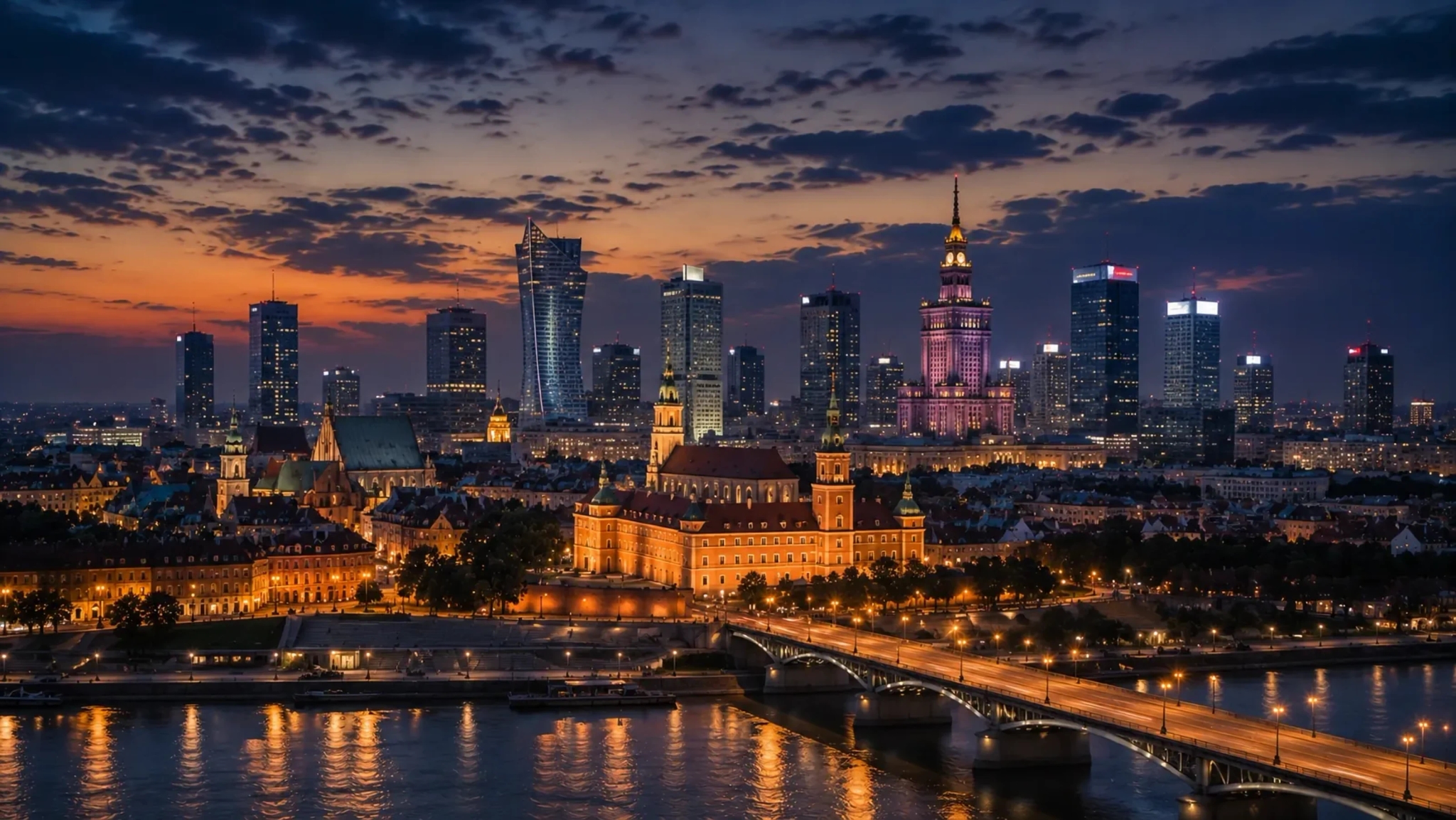
Traveler's guide • The Poland border
Ukraine – Poland Border Crossing: The Complete 2026 Guide
Nine road checkpoints, queues that shift by the hour, and rules the government fine-tunes every few months — crossing the Ukraine–Poland border is rarely a simple affair. This guide covers everything you need before the trip: documents for adults and children, customs rules, insurance, pet travel, and practical tips for crossing faster.
The Ukraine – Poland border in 2026: what changed and what hasn't
Poland remains Ukraine's main gateway to the European Union — tens of thousands of people cross daily: students, entrepreneurs, families, drivers on international routes. While the physical infrastructure hasn't changed in years (the same nine road checkpoints), the procedural details — document requirements, customs thresholds, rules for men of conscription age — are updated by government resolutions several times a year.
This guide is built exclusively on official sources — the State Border Guard Service of Ukraine (dpsu.gov.ua), the State Customs Service (customs.gov.ua), the Ministry of Foreign Affairs (mfa.gov.ua), Poland's Straż Graniczna (strazgraniczna.pl), the gov.pl portal, and official European Union documents. Where details can change soon — a checkpoint's operating mode, specific fines — we flag it directly and point you to where to verify the current status yourself.
Carrier's tip: keep a short checklist for every trip — passport, military registration document (for men), vehicle registration and driver's licence, Green Card, and cash for any documents you might still need to arrange. Half of all border delays come not from queues but from a forgotten document.
What to know before the trip
Split your preparation into four blocks: documents (yours and the vehicle's), finances (cash, cards, insurance), customs limits (what you can carry), and logistics (which checkpoint, when to leave, how much time to budget). A mistake in any one of these is the most common reason a three-hour trip turns into a twelve-hour one.
- Check your passport's validity — at least 3 months beyond your return date is recommended.
- Make sure it's biometric — that's what grants visa-free EU entry.
- If driving, arrange a Green Card policy in advance, not at the checkpoint.
- Check for any exit restrictions via the official DPSU service if debts or court decisions are a concern.
- Men of conscription age should assemble the full document package proving their ground for travel.
- Declare cash if the amount exceeds the equivalent of €10,000.
- Check the current queue status at your chosen checkpoint right before departure.
Weigh your mode of travel too. A private car gives flexibility but adds responsibility for insurance and the vehicle's condition. A bus removes the driving but ties you to a schedule and a queue shared with dozens of other passengers. A private transfer combines a car's comfort with a driver who handles documents, routing and the queue for you — more on that below.
Sources: State Border Guard Service of Ukraine, State Customs Service of Ukraine.
Documents you need to cross the border
The basic document is a Ukrainian foreign travel passport. For visa-free entry to Poland and the rest of the Schengen area, it must be biometric — holders of the old-style passport without a chip aren't entitled to visa-free entry and need a visa. Visa-free travel covers private trips — tourism, family visits, business contacts, seminars and conferences — not employment or business activity in Poland.
The general rule is up to 90 days within any 180-day period, and the limit is counted cumulatively across the whole Schengen area, not per country. Days spent in Poland, Germany or Czechia within the same 180-day window add up. Overstaying can mean a refusal of entry on your next trip.
- Biometric foreign travel passport — required for the driver and every passenger.
- Driving licence and vehicle registration — if crossing in your own car.
- Green Card international motor liability insurance — for the vehicle.
- For men aged 18–60 — a military registration document (paper or in the Reserve+ app) and, if applicable, documents confirming the ground for travel.
- Proof of purpose and financial means — in case a Polish border guard asks additional questions (bookings, invitations, bank statements).
Men of conscription age deserve special attention. Since 27 August 2025, men aged 18–22 inclusive cross without additional grounds — just a passport and a military registration document; from 1 March 2026, that document must carry a valid VIN or QR code checked against the Obereg registry. Men 23–60 may only leave under one of the grounds defined by the Cabinet of Ministers — being a father of many children, sole child-rearing, disability, a business trip, studying abroad, and others. The full breakdown lives in a dedicated guide, "Border crossing rules for men of conscription age in Ukraine in 2026".
Sources: Ministry of Foreign Affairs of Ukraine, State Border Guard Service of Ukraine.
Documents children need
Minor Ukrainian citizens cross the border with one of: their own foreign travel passport, a diplomatic or service passport, a valid child travel document, or — for the duration of martial law — provided the child is entered in a parent's foreign passport, or with a birth certificate. This rule is set directly by the State Border Guard Service of Ukraine, and it's the most common source of confusion since pre-war requirements were different.
When notarized consent from the other parent is required
If a child under 16 leaves with one parent and the other parent isn't present at the checkpoint, the general rule requires notarized consent from the absent parent, naming the destination country and trip duration. The same consent — from both parents — is required if the child is accompanied by anyone else: a grandparent, an adult sibling, another relative or acquaintance.
When notarized consent isn't required
- The other parent is a foreigner or stateless, as recorded on the birth certificate.
- The accompanying parent's passport shows permanent residence abroad or consular registration.
- The other parent has died — with a death certificate.
- The other parent has been deprived of parental rights, declared missing, or incapacitated — by court ruling.
- The mother has single-mother status, confirmed by the civil registry office.
- The other parent's child-support arrears exceed four months — confirmed by the enforcement service.
- The child has a disability or serious illness — medical confirmation suffices for trips over one month.
- For temporary trips under one month — with a court or guardianship authority decision confirming the child lives with the accompanying parent.
Under martial law, the decision to admit a minor without notarized consent may in specific cases account for the accompanying adult's status — whether they fall under categories exempt from military service and mobilization. Because the list of grounds is updated regularly, verify the current rules on the DPSU's official page or consult a lawyer before traveling with a child without both parents.
Sources: DPSU — minors crossing the border, DPSU — procedure for minors leaving Ukraine.
Traveling by car
Crossing by car is the most flexible way to reach Poland — you choose the checkpoint, the time, and the route beyond it. It's also the most queue-sensitive mode, since a checkpoint's passenger-car throughput is limited by the number of lanes and per-vehicle processing time.
- Vehicle registration and driving licence — required on every trip.
- Your Green Card must cover Poland for the entire planned stay.
- Check your vehicle category against the checkpoint's limits (Hrushiv, for example, only takes passenger cars up to 3.5 t).
- Fill the tank in advance — queues can run for hours, and some checkpoints have no nearby fuel stations.
- Carry a first-aid kit, a warning triangle and a reflective vest — standard requirements in both Ukraine and Poland.
All nine checkpoints take passenger cars, while only some take freight, with differing weight categories (see the checkpoints section below). If driving a car that isn't yours, carry a power of attorney or proof of your right to use it — standard practice on both sides of the border.
Sources: State Border Guard Service of Ukraine — 9 road checkpoints.
Traveling by bus
Regular international bus routes remain the most accessible way to reach Poland without a car. Buses cross through the same road checkpoints as passenger cars but go through a separate lane and a collective control process — border guards usually check passengers' documents on board or in a dedicated area of the checkpoint.
The main downside is the collective queue: if one passenger has a document issue, the whole bus waits. An alternative is rail — Mostyska–Przemyśl is the best-known rail checkpoint, served by passenger trains toward Warsaw.
A bus suits light travelers who don't need route flexibility and can budget extra time for both the wait and the ride itself. If a predictable trip length, private space, or extra luggage matters more, consider a private transfer.
Traveling by private transfer
A private transfer removes the main problem of a self-planned trip — uncertainty. Instead of tracking queues, picking a checkpoint, and worrying about your vehicle's paperwork yourself, a driver who makes this crossing regularly handles it.
- A fixed price agreed in advance — independent of queue length.
- The driver picks the least congested checkpoint based on direction and time of day.
- A vehicle with a valid Green Card and a complete document set — no extra prep on your side.
- Door to door — from your address in Ukraine to your destination in Poland, no bus-station transfers.
- Private space in the cabin — valuable for families with children, business trips, and extra luggage.
LP BLACKLINE runs transfers on the Kyiv — Warsaw and Kyiv — Krakow routes, and arranges trips to Lviv, Rzeszów and other Polish cities on request. Business-class cars, drivers experienced with regular international trips, and 24/7 dispatch — see all the routes we cover on the directions page.
Border checkpoints between Ukraine and Poland
Nine international road checkpoints officially operate on the Ukraine–Poland border — six in Lviv region and three on the Volyn side. All carry 24-hour, international status, though the categories of transport they accept differ significantly. Beyond the road checkpoints, several rail checkpoints also serve the border, but the nine road crossings handle the bulk of passenger cars, buses and private transfers.
| Checkpoint (Ukraine) | Checkpoint (Poland) | Region | Transport categories | Schedule |
|---|---|---|---|---|
| Krakovets | Korczowa | Lviv region, Yavoriv district | Cars, buses, trucks | 24 hours |
| Shehyni | Medyka | Lviv region, Mostyska district | Cars, buses, trucks, pedestrians | 24 hours |
| Rava-Ruska | Hrebenne | Lviv region, Zhovkva district | Cars, buses, trucks | 24 hours |
| Smilnytsya | Krościenko | Lviv region, Staryi Sambir district | Cars, buses, trucks up to 7.5 t | 24 hours |
| Hrushiv | Budomierz | Lviv region, Yavoriv district | Cars up to 3.5 t | 24 hours |
| Nyzhankovychi | Małhowice | Lviv region, Sambir district | Cars, cargo up to 3.5 t | 24 hours |
| Yahodyn | Dorohusk | Volyn region, Lyuboml district | Cars, buses, trucks | 24 hours |
| Ustyluh | Zosin | Volyn region | Cars, buses (passenger traffic only) | 24 hours |
| Uhryniv | Dołhobyczów | Lviv region, Sokal district | Cars, buses, trucks from 7.5 t (since Dec 2023) | 24 hours |
Krakovets–Korczowa is the largest checkpoint by traffic volume and takes both passenger and freight transport — expect the longest queues here, especially for trucks. Shehyni–Medyka is one of the few with a dedicated pedestrian crossing. Rava-Ruska–Hrebenne is a good alternative during peak periods. Smilnytsya–Krościenko handles trucks up to 7.5 t through the mountainous southwest of Lviv region. Hrushiv–Budomierz takes only passenger cars up to 3.5 t. Nyzhankovychi–Małhowice tends to be less congested than the crossings on the Lviv–Krakovets route.
Yahodyn–Dorohusk is the main checkpoint on the Volyn direction and one of the largest freight crossings — a good choice for routes from Kyiv and northern Ukraine that don't need to detour through Lviv region. Ustyluh–Zosin serves passenger traffic only, with no freight. Uhryniv–Dołhobyczów is the newest of the nine, opened in 2016, with truck traffic (7.5 t+) allowed since December 2023 — importantly, it has no veterinary or phytosanitary control post, so pet owners should choose a different checkpoint.
Sources: DPSU — Krakovets (Korczowa), DPSU — Shehyni (Medyka), DPSU — Rava-Ruska (Hrebenne), DPSU — Smilnytsya (Krościenko), DPSU — Hrushiv (Budomierz), DPSU — Nyzhankovychi (Małhowice), DPSU — Yahodyn (Dorohusk), DPSU — Ustyluh (Zosin), DPSU — Uhryniv (Dołhobyczów), granica.gov.pl.
How Ukrainian border control works
Leaving Ukraine, a vehicle goes through two services in sequence — border control (documents and grounds for crossing) and customs control (what and how much is being transported). Both usually happen in the same area of the checkpoint, and everyone should carry document originals.
- The border guard checks the passports of the driver and passengers against databases.
- For men 18–60 — the military registration document is checked, and from 1 March 2026 also its VIN or QR code against the Obereg registry.
- If exit restrictions apply (debts, court rulings, criminal proceedings) — additional checks or a refusal are possible.
- Customs control — declaring cash above the threshold, checking transported goods.
- Vehicle documents are checked — registration, licence, Green Card.
The final decision on crossing rests with the border guard on duty, even with a formally complete document set. Stay calm, answer questions directly, and carry originals rather than photos on your phone.
How Polish border control works
Entry to Poland is governed by the Schengen Borders Code — the single EU-wide rulebook for third-country nationals. Straż Graniczna checks five conditions at once: a valid travel document; a visa if required (not required for Ukrainians with a biometric passport); a justified purpose and conditions of the planned stay; sufficient means of subsistence; and no threat to public policy, security or health.
In practice, this means a border guard may ask about your purpose, where you'll stay, how long, and your financial means. A return ticket, accommodation booking, an invitation, or a bank statement aren't formally required for Ukrainians with visa-free status, but they speed up the check and reduce follow-up questions.
Customs control on the Polish side checks compliance with EU rules on goods, cash and animal products — see the customs and prohibited-items sections below.
Sources: Regulation (EU) 2016/399 (Schengen Borders Code), Straż Graniczna Rzeczypospolitej Polskiej.
Customs rules
Customs rules apply in both directions and are governed by different bodies of law: the Customs Code of Ukraine on the Ukrainian side, EU rules on the Polish side.
Importing goods into Ukraine is governed by Article 374 of the Customs Code: crossing by car or train, goods worth up to €500 and weighing up to 50 kg are duty-free; by air, the threshold is €1,000. The allowance applies no more than once per day. Goods above these thresholds but under €10,000 must be declared and are subject to a 10% import duty plus VAT on the excess.
Entering the EU, a separate VAT/excise exemption threshold applies to personal belongings: €300 for land travelers, €430 for air and sea. EU member states may set a lower threshold for travelers under 15, but not below €150.
Sources: Customs Code of Ukraine, Art. 374, State Customs Service of Ukraine, European Commission — traveler tax and customs exemptions.
What you can carry across the border
Within the thresholds above, personal belongings, gifts and goods for personal use can cross without written declaration. Alcohol and tobacco carry separate EU quantity limits, independent of the value threshold.
| Category | Allowance entering the EU |
|---|---|
| Tobacco | 200 cigarettes, or 100 cigarillos, or 50 cigars, or 250 g tobacco (some EU states apply a lower limit — as low as 40 cigarettes) |
| Still wine | 4 litres |
| Beer | 16 litres |
| Spirits (over 22%) | 1 litre — or 2 litres of fortified/sparkling wine instead |
| Cash | Up to €10,000 equivalent — no written declaration |
These limits cover personal, non-commercial transport. If a quantity clearly exceeds reasonable personal needs, customs may treat it as commercial movement with the corresponding paperwork and taxation, regardless of its formal value.
Sources: Your Europe — alcohol, tobacco and cash rules in the EU.
What's prohibited across the border
The list of prohibited items is set by the Customs Code of Ukraine and aligned EU rules. Some restrictions apply symmetrically, others are specific to EU entry.
- Combat weapons, ammunition and parts thereof without a special permit.
- Narcotic and psychotropic substances.
- Toxic, potent, explosive and radioactive substances.
- Cultural and historical valuables without a permit from the competent authority.
- Materials promoting violence, racism or war.
- Unmarked or illegally marked excise goods, including alcohol and tobacco without excise stamps.
A separate, important category for anyone heading to Poland is animal-origin products. EU rules ban personal import of meat, milk and dairy from third countries, Ukraine included — sausages, lard, cheese, fermented dairy products. The only exception is infant formula and medical food up to 2 kg in undamaged factory packaging that doesn't need refrigeration.
Hiding a prohibited item isn't a way to slip past control — it's grounds for a customs offense or even criminal liability for smuggling. When in doubt, declare it or leave it at home.
Currency: how much cash you can carry
Cash and precious-metal transport rules follow the same logic in both directions, built around a single threshold — €10,000 equivalent per person, converted at the official NBU rate on the day of crossing.
- Up to €10,000 equivalent per person — no written declaration needed.
- €10,000 or more — written customs declaration required.
- For groups, the threshold applies per person — it effectively doubles for a couple, and multiplies for a family.
- The same €10,000 threshold applies entering the EU, under Regulation (EU) 2018/1672 on cash controls.
- "Cash" for customs purposes includes not just banknotes but traveler's cheques, prepaid cards and bullion.
If traveling as a large family or group with cash near the threshold, declare it even if not strictly required — it avoids questions at both checks and documents the funds' legitimate origin. For everyday spending in Poland, cards are more convenient; keep cash for toll roads, small services, and as a backup if cards fail at the checkpoint.
Sources: State Customs Service of Ukraine, Regulation (EU) 2018/1672 on cash controls.
Insurance for the trip
For Ukrainians crossing visa-free on a biometric passport, medical insurance isn't formally one of the five Schengen Borders Code entry conditions — unlike Schengen visa holders, for whom it's mandatory. In practice, though, that doesn't mean it's optional.
A medical insurance policy can serve as evidence of "sufficient means" that a border guard is entitled to assess, and without it, any medical care in Poland is billed at full commercial rates. Ukrainian consulates traditionally recommend arranging travel insurance for every trip abroad regardless of formal entry requirements.
- Arrange medical insurance in Ukraine before departure, for the whole planned stay.
- Check it covers your destination and includes repatriation for serious cases.
- For car trips, a medical policy doesn't replace a Green Card — they serve different purposes.
- Keep digital and paper copies separate from your other documents.
Sources: Regulation (EU) 2016/399, Art. 6 — entry conditions for third-country nationals.
Green Card: mandatory vehicle insurance
The Green Card is an international motor third-party liability policy, valid within the international Green Card system, confirming coverage equivalent to the requirements of the country where the vehicle is located. In Ukraine, this is governed by the law "On compulsory insurance of civil liability of owners of land vehicles," with licensed insurers issuing policies under the oversight of the Motor (Transport) Insurance Bureau of Ukraine.
Since Poland belongs to the international Green Card system, a valid policy is mandatory for any Ukrainian-registered vehicle entering its territory. It covers damage caused to third parties in an accident you're at fault for, but not damage to your own vehicle or health — that requires separate coverage (CASCO, medical insurance).
- Arrange the Green Card in advance with a licensed insurer — don't count on getting one at the checkpoint.
- Confirm the policy's coverage area includes Poland (the "PL" marking on the form).
- The policy's term should cover your entire planned stay abroad, with margin.
- Not carrying a valid policy on entry to Poland can lead to fines from Polish authorities and complicate entry.
Sources: Law of Ukraine "On compulsory civil liability insurance for owners of land vehicles".
Traveling with pets
Moving dogs, cats and ferrets across the Poland border follows EU rules for pets from third countries — a category Ukraine belongs to, not the simplified-entry group. That means the full requirement set applies unless the animal already holds an EU pet passport.
- Microchipping — a readable ID chip implanted before or at the same time as the rabies vaccination.
- Rabies vaccination — the animal must be at least 12 weeks old at the time of vaccination.
- Rabies antibody titer test — required without a valid EU pet passport; at least three months must pass between the blood draw and EU entry.
- Veterinary health certificate — issued by an official state vet before travel, confirming all the above.
If the animal already has an EU-format passport issued before its first departure from the EU, with vaccination records up to date, no repeat antibody test or new certificate is needed for the return trip — the passport alone suffices. Choose a checkpoint with veterinary control and confirm it in advance — Uhryniv, for example, has no veterinary or phytosanitary control post.
Sources: Poland's Chief Veterinary Inspectorate — requirements for Ukraine, Portal Gov.pl — pet transport.
Traveling with children: practical tips
Beyond the documents covered above, a trip with children has a practical dimension too: a checkpoint queue can last hours, and small children handle a confined car or bus poorly for that long.
- Plan departure so most of the wait falls during the child's nap.
- Pack extra water, snacks, wipes and a change of clothes, even for a short trip.
- An age- and weight-appropriate car seat is mandatory in both Ukraine and Poland.
- Keep the child's documents — birth certificate, passport, notarized consent if needed — in a separate, accessible folder.
- If the child takes regular medication, carry a prescription or medical note in English or Polish.
A private transfer is often more comfortable for families with children — no transfers, the option to stop when needed, and more personal space reduce the strain compared to a bus or a queue in your own car among dozens of others.
Common reasons for refusal at the border
A crossing can be refused on either side, for fundamentally different reasons. On the Ukrainian side, it's usually about exit restrictions on a specific person; on the Polish side, about not meeting Schengen entry conditions.
Reasons on the Ukrainian side
- Evading a court decision, including child-support arrears.
- Access to state secrets.
- An open criminal case, conviction, or unserved sentence.
- Administrative police supervision.
- A preventive measure barring exit until criminal proceedings conclude.
- Confirmed tax or loan debt.
- For men 18–60 — no ground for exit, an invalid military registration document, or, from 1 March 2026, a mismatch with the Obereg registry.
Reasons on the Polish / EU side
- An invalid, damaged, or soon-to-expire travel document.
- The 90/180-day Schengen stay allowance already used up.
- An insufficiently justified purpose or unproven financial means.
- A prior migration violation — an overstay on an earlier trip.
- Suspicion the real purpose is unauthorized employment, not a private visit.
- A threat to public policy, security or health flagged in EU information systems.
In every case, the on-duty border guard makes the final call based on the full set of documents and circumstances. Check for exit restrictions from Ukraine in advance through the official DPSU online service — it takes minutes and avoids an unpleasant surprise at the checkpoint.
Sources: Law of Ukraine "On the procedure for citizens of Ukraine leaving and entering Ukraine", Regulation (EU) 2016/399, Art. 6, DPSU — check exit restrictions online.
How to reduce border wait time
Queues shift more dynamically over the day and week than they appear, which is why checking the current situation right before departure beats simply leaving "earlier."
- Follow the DPSU's Telegram channel — checkpoint load infographics are updated several times a day.
- Use the DPSU's official "Cherga" (Queue) app (iOS/Android) or the interactive map at dpsu.gov.ua/uk/map.
- On the Polish side, check estimated wait times on granica.gov.pl or the "Granica" mobile app.
- Avoid Friday evenings, Sundays, and the days before public holidays — traditionally the busiest.
- Consider less popular checkpoints — Nyzhankovychi, Smilnytsya, or Ustyluh — instead of the busy Krakovets or Shehyni.
- An early-morning or overnight crossing usually means a shorter queue than a daytime one.
Another practical option is to leave the routing to a professional carrier. Drivers who cross regularly track the current situation at each checkpoint and can switch routes quickly if a usual crossing suddenly backs up.
Sources: DPSU — Telegram channel, DPSU — "Dovira" hotline, granica.gov.pl.
Advice from international carriers
Years of regular trips to Poland have taught the LP BLACKLINE team a few practical rules rarely written into official instructions, but that genuinely affect how smoothly a trip goes.
- Never rely on a single electronic copy — a photo of a passport on your phone doesn't replace the original, and a dead phone at the border isn't rare.
- Fuel up and plan meal stops before you reach the checkpoint, not in the queue — some crossings have no nearby infrastructure.
- Keep documents in the order they'll be requested: passports first, then vehicle documents, then, if needed, proof of the ground for travel.
- If traveling with children or elderly passengers, mention it early — some checkpoints have separate, faster lanes for these categories.
- Don't be alarmed by extra questions from a border guard — it's standard practice, not a sign something's wrong with your documents.
- Plan your route with time to spare — even under favorable conditions, a crossing rarely takes less than 30–60 minutes.
That's exactly why many clients choose a transfer over a self-planned trip: an experienced driver absorbs all this operational load, so the passenger spends the trip resting instead of tracking queues and paperwork.
Conclusion
Crossing the Ukraine – Poland border in 2026 remains a procedure with clear rules that are, nonetheless, periodically refined by government resolutions on both sides and by decisions at the EU level. The anchors stay constant: a biometric passport for visa-free entry, a valid Green Card for the vehicle, staying within customs thresholds, and, for men of conscription age, a legally defined ground for travel.
The best strategy is to prepare in advance rather than at the checkpoint: gather a complete document set, check for restrictions, declare what needs declaring, and verify the current queue situation right before departure. And if you'd rather remove that preparation from your list entirely — get in touch: the LP BLACKLINE team arranges transfers to Poland at a fixed price, with a complete vehicle document set and a driver who knows all nine checkpoints as well as the DPSU's own map. Heading to Moldova instead? Our Ukraine – Moldova border crossing guide may help too.

Frequentlyasked questions
Answers to the most common questions about crossing the Ukraine – Poland border in 2026.
Have a question?
Get in touch with us — we'll provide all the information you need and help arrange your transfer.
Contact usNine road checkpoints: Krakovets, Shehyni, Rava-Ruska, Smilnytsya, Hrushiv and Nyzhankovychi in Lviv region, plus Yahodyn, Ustyluh and Uhryniv on the Volyn side. All operate 24 hours, but accept different transport categories.
Krakovets (Korczowa) is the largest by traffic volume and takes cars, buses and trucks. High traffic also means it often has the longest queues.
Yes, a pedestrian crossing operates at the Shehyni — Medyka checkpoint.
A biometric Ukrainian foreign travel passport. Old-style passports without a chip don't qualify for visa-free entry and need a visa.
Up to 90 days within any 180-day period, counted cumulatively across the whole Schengen area, not just Poland.
Generally yes, for a child under 16 — notarized consent from the absent parent is required. Exceptions include a foreign or deceased second parent, loss of parental rights, over four months of child-support arrears, or single-mother status.
For the duration of martial law, crossing is allowed if the child is entered in a parent's foreign passport, or with a birth certificate, per DPSU rules.
Yes, since 27 August 2025, men 18–22 inclusive cross without extra grounds, just a passport and military registration document. From 1 March 2026, that document needs a valid VIN or QR code.
Only under one of the grounds set by the Cabinet of Ministers — being a father of many children, sole child-rearing, disability, a business trip, studying abroad, and others. See our dedicated guide for the full list.
It's an international motor third-party liability policy. It's mandatory for any Ukrainian-registered vehicle entering Poland, which belongs to the international Green Card system.
Up to €10,000 equivalent per person, without written declaration. At or above that, declaration is mandatory both leaving Ukraine and entering the EU.
By car or train — goods worth up to €500 and weighing up to 50 kg; by air — up to €1,000. The allowance applies no more than once per day.
No. EU rules ban personal import of meat, milk and dairy from third countries, Ukraine included. The exception is infant formula and medical food up to 2 kg in factory packaging.
4 litres of still wine, 16 litres of beer, plus 1 litre of spirits over 22% (or 2 litres of fortified/sparkling wine instead) — per adult.
Up to 200 cigarettes, or 100 cigarillos, or 50 cigars, or 250 g of tobacco. Some EU states apply a lower limit — as low as 40 cigarettes — so check current rules for Poland.
It isn't formally required for biometric passport holders, but it can support proof of sufficient means, and without it medical care in Poland is billed at full commercial rates.
Microchipping, rabies vaccination (no earlier than 12 weeks of age), and, without a valid EU pet passport, a rabies antibody titer test taken at least three months before entry, plus a veterinary certificate.
Uhryniv (Dołhobyczów) has no veterinary or phytosanitary control post, so choose a different checkpoint for pet travel.
Most commonly: child-support arrears, an open criminal case, administrative police supervision, tax debt, or, for men 18–60, no valid ground for exit or an invalid military registration document.
An invalid document, an exhausted 90/180-day Schengen allowance, an insufficiently justified purpose, unproven financial means, or suspected intent to work illegally.
Through the State Border Guard Service of Ukraine's official online service, which checks restrictions in real time.
Follow the DPSU's Telegram channel with queue infographics, use its "Cherga" app, or check granica.gov.pl and the "Granica" mobile app on the Polish side.
Friday evenings, Sundays, and days before public holidays are traditionally the busiest. Early morning or overnight crossings usually mean shorter queues.
A transfer combines a car's flexibility (door to door, no transfers) with an experienced driver handling the vehicle's paperwork, choosing the least congested checkpoint, and driving the trip itself.
Yes, LP BLACKLINE runs transfers on the Kyiv — Warsaw and Kyiv — Krakow routes, and arranges trips to other Polish cities on request.
Combat weapons, ammunition and parts thereof are prohibited without a special permit from the competent authorities.
They aren't formally required for Ukrainians with visa-free status, but having them speeds up the check since they confirm your purpose and trip length.
Getting ready for a trip to Poland?
We arrange a private transfer to the border and beyond — at a fixed price, with a complete vehicle document set, and dispatch day and night.